
CLASS THREE – VIDEO and NOTES
Here are some relevant notes from this class:
2nd Century Controversy: Marcionism
Recommended Article: Marcion and Getting Unhitched from the Old Testament by Kevin Deyoung]
https://www.thegospelcoalition.org/blogs/kevin-deyoung/marcion-getting-unhitched-old-testament/
History of Marcion:
QUOTES:
Textbook “Marcionite churches appeared, modeled on orthodox congregations. They had their own ministers and rituals. For example, they did not use wine at communion, as a result of the ascetic emphasis of their teaching. Some of the Marcionite beliefs spilled over into the various gnostic sects, and Marcionites were themselves affected by gnostic views. Their ideas spread, however, throughout Italy, and as far afield as Arabia, Armenia, and Egypt. In the East they exercised a considerable influence for many decades. A number of Marcionite villages existed near Damascus as late as the fourth century.”
Heresies and How to Avoid Them “For him, there was a fundamental contradiction between law and love, righteousness and grace. Marcion thought that true Christianity was flawed by the incompatibilities at the heart of its teaching. His solution was radical. Nothing less than a restatement of faith would do, and for Marcion that restatement had to focus on what for him was the essential gospel: the love, mercy and compassion displayed in the life and teachings of Jesus. This, for him, was all that was necessary, it was the blueprint for a new and pure humanity. There was no other truly Christian foundation for belief or morality.” (cited in article by Deyoung)
Bart Erman, textual critical scholar “We know of two books from Marcion. The first was his own composition, the Antitheses… a book that appears to have laid out in stark contrast the differences between the God of the Jews who gave the Law and the previously unknown God of Jesus who provided salvation. Marcion claims he learned of this contrast from the writings of the apostle Paul, his hero, who did indeed differentiate between his “gospel” and the law. His second book was his canon of Scripture, an edited collection of ten of Paul’s letters and a version of the Gospel of Luke.” (https://ehrmanblog.org/more-on-marcions-theology/)
THE QUESTION OF CANON
The 4 Steps of the Revelatory Process
A. Inspiration
B. Canonization
C. Transmission
D. Translation
Three ways to understand Canon (according to Michael Kruger).
Ontological Canon — what comes into being as a result of revelation.
Functional Canon — what the church recognizes to be revelation.
Exclusive Canon — when the church recognizes the canon to be closed
THE KEYS TO CANON HISTORY:
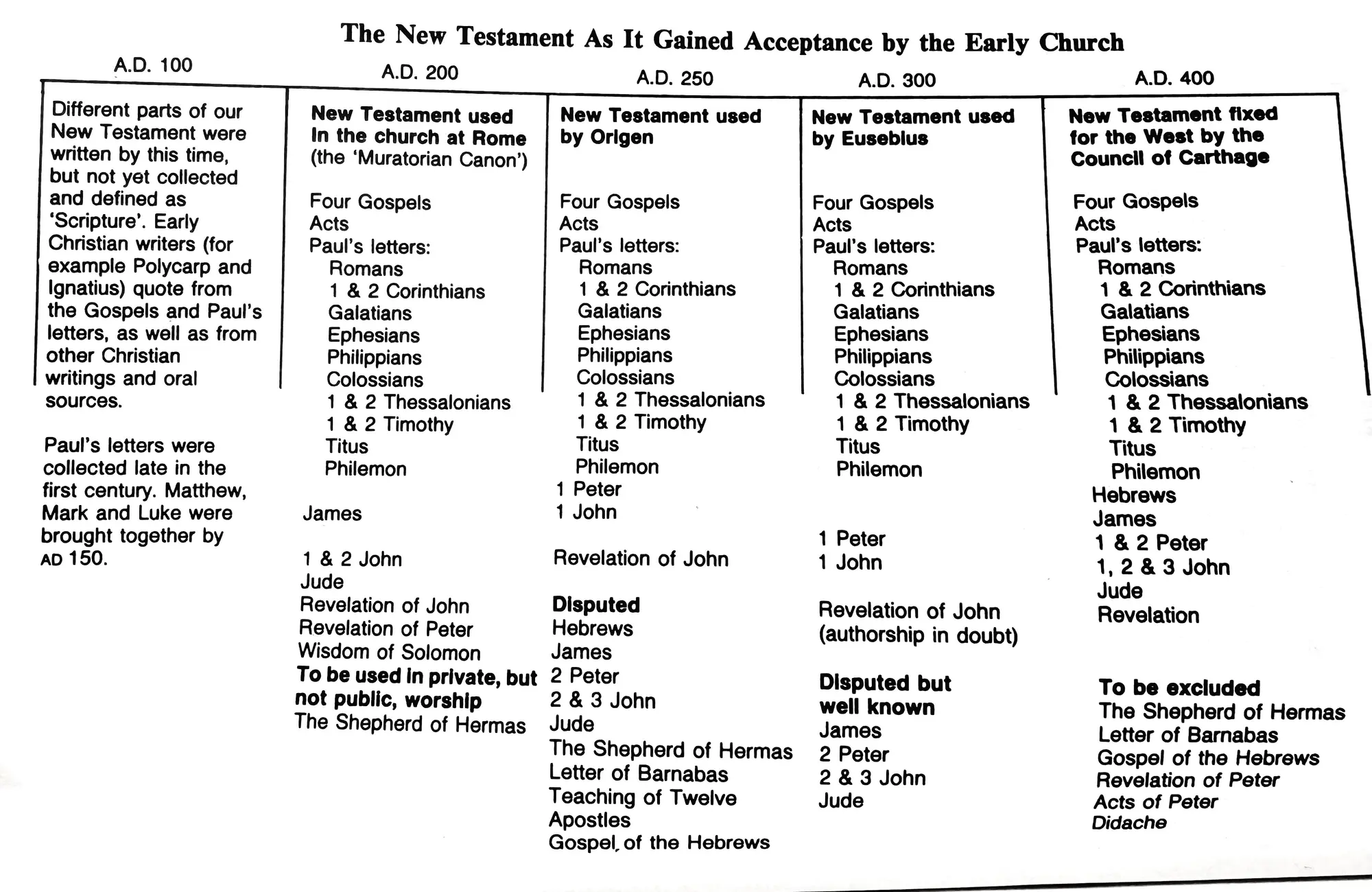
The 4 Gospels and Paul’s letters were among the earliest to be recognized and accepted.
The books are immediately determined by God; He then leads His church to discover them.
The discovery of the canon takes place over time; therefore early lists can change.
Chart (taken from previous editions of the textbook, but no longer in the current edition)

Sovereign Grace Academy is a biblical studies ministry provided by Sovereign Grace Family Church. Students of the ministry will be provided seminary quality instruction with no financial obligation. Courses are provided in a wide range of subjects.